Not sure how to ask for your amigos’ emails?
In this lesson from Spanish for Beginners with Marco podcast, you’ll learn all the essentials for giving and asking for people’s emails in Spanish.
You’ll learn:
📧 How to ask “What’s your email?”
💬 The Spanish word for the sign “@”
💻 Essential vocabulary for emails
Ready for this? ¡Vamos!
Your First Confident Steps en Español
Get your FREE Spanish Starter Pack, 30 beginner lessons for a solid start en español.
Ebook + audio lessons included.
Unsubscribe anytime.
How to say email in Spanish
The word for email is “correo electrónico”.
However, it’s very common to simply say “correo.”
Other alternatives include using the English words: mail or email.
All of these options are understood by native Spanish speakers.
Useful Phrases to Ask and Give Your Email
To ask someone’s email in Spanish use:
¿Cuál es tu correo? (What’s your email?)
To answer say:
Mi correo es… + your email
These simple common phrases are all you need to exchange correos.
Spanish Email Words
Let’s look at the parts of an email and how to mention each one in Spanish.
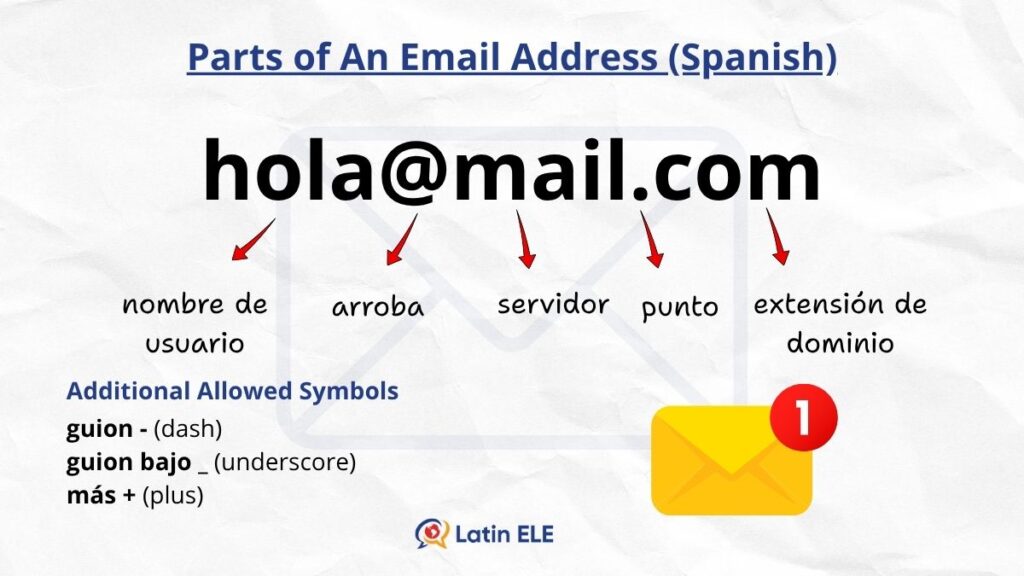
Nombre de usuario: user name
@: arroba
Punto (.): dot
Guion (-): dash
Guion bajo (_): underscore
Spanish Beginner Email Dialogue Transcript
In this episode, you listened to a short conversation of two people exchanging their emails.
Here is the transcript.
| Speaker: | Spanish (Original) | English (Translation) |
|---|---|---|
| Marco: | ¿Cuál es tu correo, Josefa? Así te envío las fotos del evento. | What’s your email, Josefa? That way I can send you the photos from the event. |
| Josefa: | Mi correo es josefa@mail.com.ar. ¿Y tu correo, Marco? | My email is josefa@mail.com.ar. And your email, Marco? |
| Marco: | Mi correo es marco@mail.com | My email is marco@mail.com. |
| Josefa: | ¡Súper! Espero las fotos. | Great! I’m waiting for the photos. |
Parts of an Email
These are the names of the parts of an email in Spanish:
Asunto: Subject line
En Copia (CC): Carbon Copy
Remitente: sender
Destinatario: recipient
Cuerpo: body of the email
How to Write an Email in Spanish
Writing emails in Spanish doesn’t have to be complicated.
Here are key considerations to keep in mind when writing your messages👇
Greetings in Formal and Informal Emails
Let’s review some Spanish greetings for emails en español.
For informal situations, use the greetings you’d use in a casual conversation.
Some options:
¡Hola! (Hi!)
¿Qué tal? (How is it going?)
Querido/-a + First Name (for close friends. The meaning is close to “Dear + name of friend”)
For more formal correspondence, avoid conversational language. Here are some common email greetings in Spanish for formal situations.
Estimado/-a Sr. (señor) / Sra. (Señora) + Last name (Dear Mr./Mrs.)
A quien corresponda (to whom it may concern, use it when you don’t know the name of the recipient)
Don / Doña + name (similar to Mr./Mrs. but “Don” and “Doña” is followed by the first name of the person)
Body of the Email: Tú vs Usted
Choosing between tú and usted is essential.
Use tú in informal, casual emails. Messages to friends, relatives, and colleagues where the tone is friendly and familiar.
Use usted in more formal situations. This form is appropriate when writing to your boss, a client, or anyone in a higher position where respect and professionalism are expected. It conveys a respectful tone.
Spanish Sign-Offs
Just like in greetings, a sign-off can be formal or informal.
Let’s look at some common farewell options to close your Spanish emails.
Friendly sign-offs 👇
Saludos (Best)
Hasta pronto (See you soon)
Un abrazo (literally ” a hug”, common among friends of any gender)
Besos (kisses, more common among women)
Formal sign-offs 👇
Saludos cordiales (kind regards)
Atentamente (sincerely)
Cordialmente (Cordially)
What’s PS in Spanish?
If you need to add extra information at the end of your correo, add a P.S. line.
The Spanish version is P.D. (postdata)
Time for practice!
Ready to test your email vocabulary?
Take the short quiz below and practice what you learned in this lesson.
Now you know the basics of emails in Spanish. Go out there and communicate with native speakers en español.
Email writing is a great exercise for learning a language. It helps you use grammar, gives you time to think, and encourages you to be concise.
Have fun!
Build Your Spanish Foundations
Starting your Spanish journey? These Spanish beginner lessons may help:
- 👋 Spanish for Beginners
- 💬Introducing Yourself in Spanish
- 🔢 How to Say Your Phone Number in Spanish
- 📅 Days of the Week in Spanish
- 📝 Practice the Spanish Present Tense
- ⏰ How to Tell Time in Spanish
- 👍Talking about likes and dislikes with Gustar
And if you’d like extra support, get your FREE Spanish Starter Pack and start building confidence in everyday Spanish conversations.