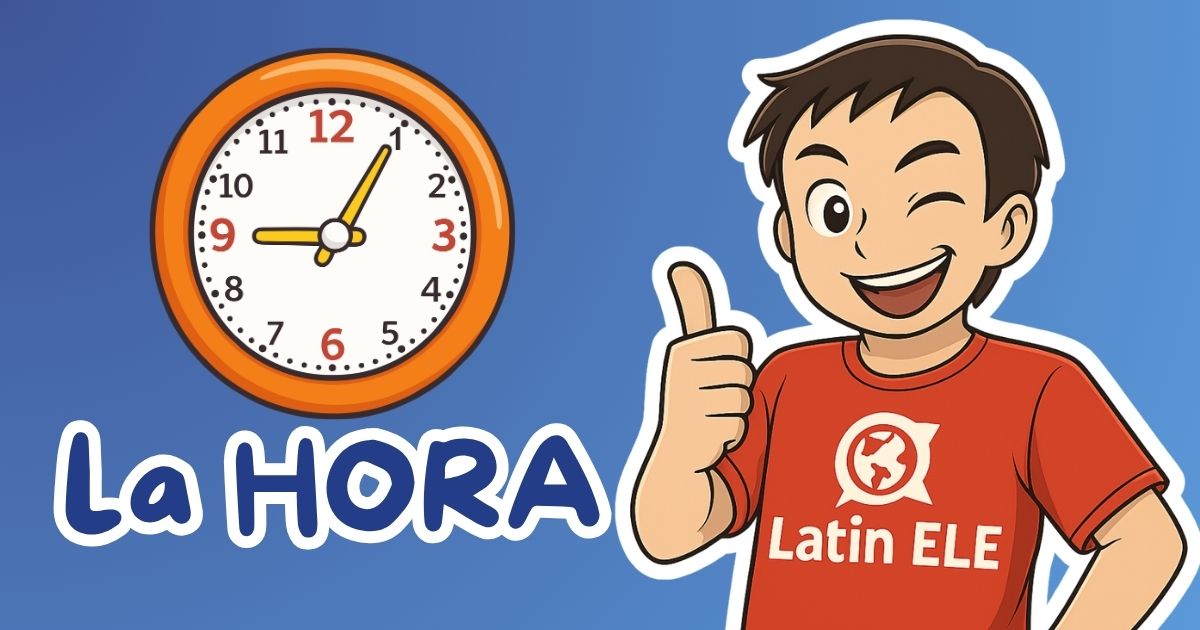
English speakers often say “¿qué tiempo es?”, imitating “what time is it?”… but that phrase means nothing en español!
So, what’s the correct way to ask the time?
In this Spanish beginner lesson, you’ll learn all the essentials to master Spanish time like a native.
You’ll learn:
⏰ How to tell the time like you were born speaking Spanish.
❌ Why you should avoid the word “tiempo” when talking about hours.
✅ Asking for the time of events to enjoy activities with your amigos.
Ready to learn Spanish? ¡Vamos!
Your First Confident Steps en Español
Get your FREE Spanish Starter Pack, 30 beginner lessons for a solid start en español.
Ebook + audio lessons included.
Unsubscribe anytime.
How to Ask for the Time: ¿Qué hora es?
The question “What time is it?” in Spanish is: “¿Qué hora es?”
Hora means hour, so native speakers use hora when talking about specific times.
That’s why saying “¿qué tiempo es?” is incorrect.
It can even confuse native speakers, who might think you’re asking about the weather: ¿Qué tiempo hace? (What’s the weather like?)
Telling the Time in Spanish
To reply to ¿Qué hora es?, Spanish speakers distinguish between 1 o’clock (singular) and times from 2 onwards (plural)
⌚️ For one o’clock say “es la una”
⌚️ From two o’clock onwards = son las + number (dos, tres, cuatro, etc.)
Adding Minutes
To tell the time in Spanish with minutes, add “y” (and) + the minutes.
Examples:
1:10 = es la una y diez
2:20 = son las dos y veinte
4:35 = son las cuatro y treinta y cinco
Sometimes Spanish speakers drop the “y” and just say the minutes next to the hour.
Example:
1: 10 = es la una diez
Quarter, Half Past, And A Quarter to
Spanish has special expressions for 15, 30, and 45 minutes:
15 = y cuarto (7:15 = son las siete y cuarto)
30 = y medio (7:30 = son las siete y media)
45 = two possible options: un cuarto para (a quarter to) or menos (less.)
Then, 7:45 can be = un cuarto para las ocho (a quarter to eight) or las ocho menos un cuarto (eight less a quarter.) Both are correct.
The Time of Events: ¿A qué hora…?
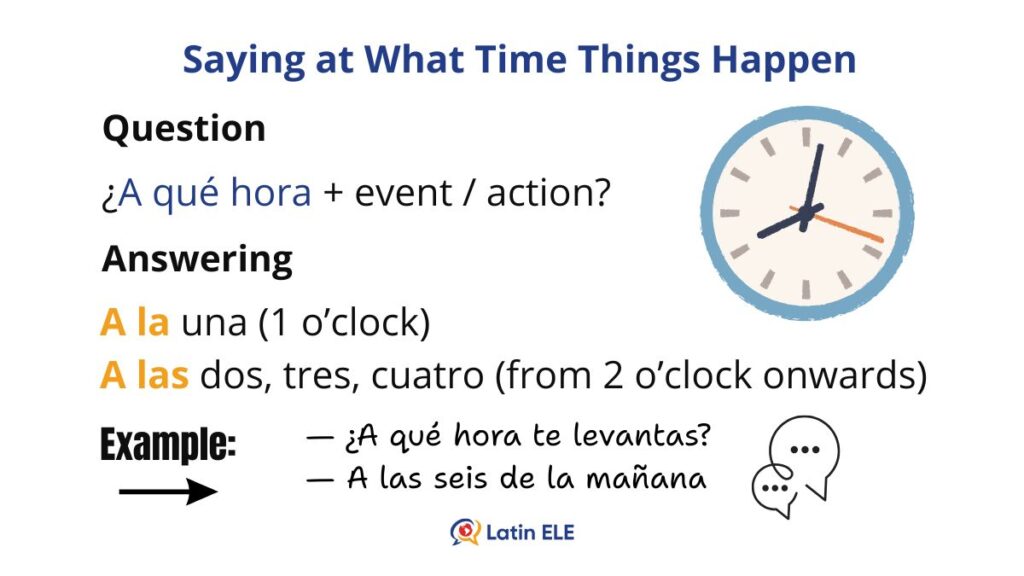
To ask when something happens, use the question ¿a qué hora + action/event?
Some examples:
⌚️ ¿A qué hora es el concierto? (What time is the concert?)
⌚️ ¿A qué hora abre el parque? (What time does the park open?
⌚️ ¿A qué hora es la fiesta? (What time is the party?)
To reply, say “a la” + una (at 1 o’ clock) or “a las” + hours from 2 onward.
Examples:
🎵 El concierto es a las siete.
🌳 El parque abre a las nueve.
🎉 La fiesta es a las diez.
Saying the Part of the Day
To tell the time in Spanish with a specific part of the day, add these expressions:
☀️ de la mañana: in the morning
🌅 de la tarde: in the afternoon.
🌙 de la noche: in the evening / at night
This is particularly useful when it’s not clear exactly when something is going to take place.
Example:
A: ¿A qué hora es el evento?
B: A las nueve.
A: ¿De la mañana?
B: No, a las nueve de la noche.
Exact Time “On the Dot”
To emphasize an exact time, say: “en punto” (on the dot)
Example:
La lección de español empieza a las tres en punto. No puedes llegar tarde.
Important Material to Review
To tell time in Spanish, you’ll need solid numbers.
Many occasions use a 12-hour clock time, but some events —especially in the evening— use a 24-hour clock.
Example:
El concierto de música clásica es a las veinte horas (the concert is at 8 o’clock in the evening).
Here is a Spanish beginner lesson teaching you numbers in Spanish.
And now you know how to say the time in Spanish! Next time your amigo says “la fiesta es a las 10 en punto“, you’ll know exactly when to show up.
And if you need extra help to get started en español, grab our FREE Spanish Starter Pack, a complete guide with 30 lessons covering all the basics for Spanish beginners.
¡Hasta pronto!
Need More Spanish Beginner Lessons?
If you’re starting your journey en español, our show Spanish for Beginners with Marco is the perfect place to begin.
This podcast offers clear, accessible lessons designed for English speakers.
Grammar is taught in meaningful, real‑life contexts so you can apply what you learn right away.
Available on all major listening apps.