

Have you been asked the question “¿De dónde eres?” but don’t know what it means or how to reply?
In this lesson you will learn how to talk about your origin in Spanish effortlessly so you can start having conversations in Spanish with your friends.
You can listen to Spanish for Beginners with Marco on all major listening apps.
💡 Part of the Spanish for Beginners Free Course
A 15-lesson audio & video guide designed to get you speaking comfortably from day one.
Your First Confident Steps en Español
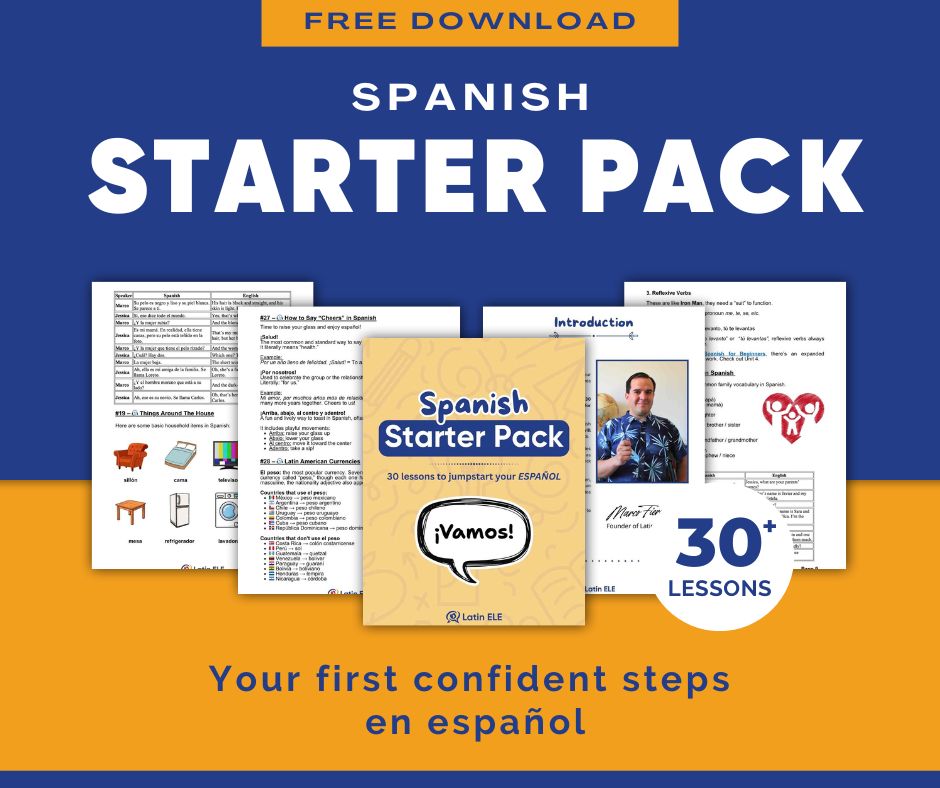
Get your FREE Spanish Starter Pack, 30 beginner lessons for a solid start en español.
Ebook + audio lessons included.
Unsubscribe anytime.
Verb “ser” = to be
It is used to talk about nationality or city of origin of somebody/something.
Conjugation of ser
Yo soy
Tú eres
Él/ella/usted es
Nosotros(as) somos
Ustedes/ellos/ellas son
You can use the nationality after “ser”
Example: yo soy chileno.
You can also mention the country. For that you need to add “from”, which is “de”.
Example: yo soy de Chile (I’m from Chile)
To ask “Where are you from?” you can say “¿De dónde eres (tú)?”
Verb “vivir” = to live
Conjugation of vivir
Yo vivo
Tú vives
Él/ella/usted vive
Nosotros(as) vivimos
Ustedes/ellos/ellas viven
We add en after vivir to mention the country or city.
Example: yo vivo en Concepción (I live in Concepción)
To ask “Where do you live?” you say ¿Dónde vives?
Country names in Spanish and their nationalities
In Spanish, country names are capitalized because they’re proper nouns. Nationalities, however, are adjectives, so they are written in lowercase. That’s the standard convention en español.
Some nationalities don’t change for men or women. Here are a few countries and their corresponding nationalities:
🇺🇸 Estados Unidos = estadounidense (for man/woman)
🇨🇦 Canadá = canadiense (for man/woman)
🇬🇧 Reino Unido = británico / británica
🇦🇺 Australia = australiano / australiana
🇲🇽 México = mexicano / mexicana
🇨🇷 Costa Rica = costarricense (for man/woman)
🇨🇴 Colombia = colombiano / colombiana
🇦🇷 Argentina = argentino / argentina
🇨🇱 Chile = chileno / chilena
🇵🇦 Panamá = panameño / panameña
Dialogue Transcript
Marco: ¡Hola! ¿Qué tal? ¿Cómo te llamas?
Jessica: Me llamo Jessica, ¿y tú?
Marco: Me llamo Marco, ¿de dónde eres?
Jessica: Soy de Medellín, Colombia.
Marco: Yo soy de Santiago, Chile. pero vivo en Concepción. ¿Dónde vives tú?
Jessica: Vivo en Concepción.
Build Your Spanish Foundations en Español
Ready to find your voice in Spanish? Dive into the full 15-lesson course below, or choose a guide to practice right now:
⭐ Spanish for Beginners – Free 15-Lesson Course: The complete audio and video roadmap to start speaking from day one.
Explore specific lessons from the series:
- 💬Introducing Yourself in Spanish
- 🎩 Tú vs. Usted: When to Use Formal vs. Informal Spanish
- 🔢 How to Say Your Phone Number in Spanish
- 🗣️ Physical Descriptions in Spanish
- ✍️ Spanish Regular Verbs in the Present Tense
- 📝 Practice the Spanish Present Tense
- ⏰ How to Tell Time in Spanish
- 👍Talking about likes and dislikes with Gustar
Want a full roadmap? Get your FREE Spanish Starter Pack and start building confidence in everyday Spanish conversations.

