
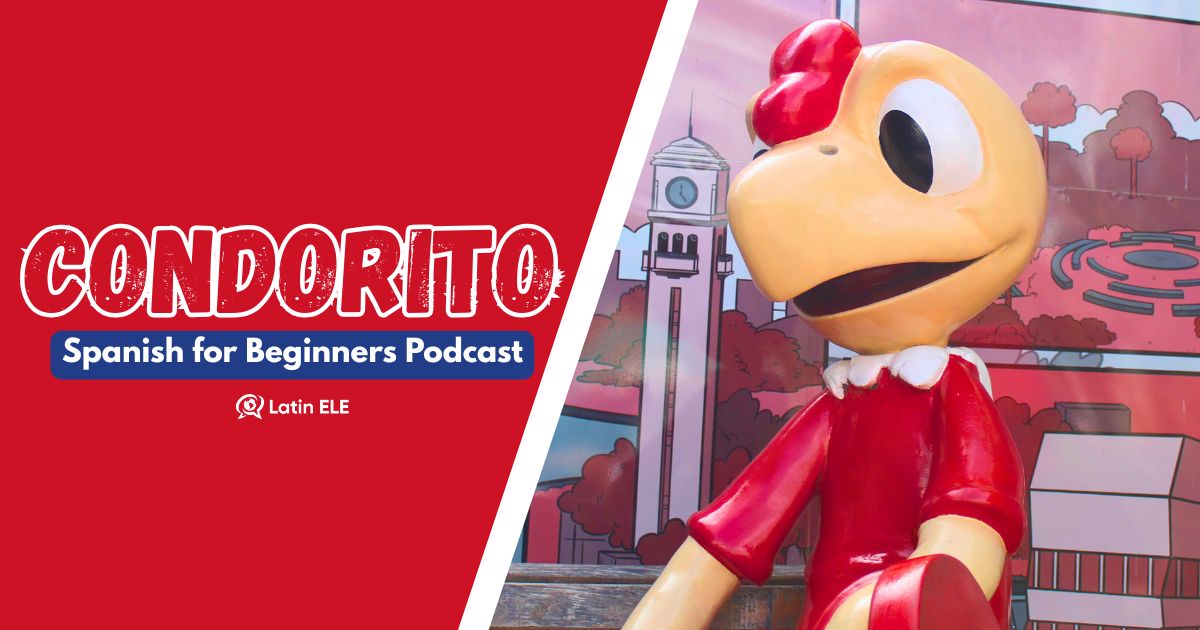
Comics are a fun and effective way to practice Spanish. The illustrations help you follow the story, while the dialogues reflect the kind of language people use in everyday conversations.
That’s why, in this episode of the Spanish for Beginners podcast, you’ll learn about one of the most famous comic strips in Latin America: Condorito.
The first Condorito comic was published in 1949, and since then it has been enjoyed by generations of Latin American readers.
In this lesson, you’ll learn:
🐦 Who Condorito is and where he’s from
📝 Vocabulary to describe a character’s personality
🎧 A listening activity in easy Spanish to boost your listening skills
Ready? ¡Vamos!
Your First Confident Steps en Español
Get your FREE Spanish Starter Pack, 30 beginner lessons for a solid start en español.
Ebook + audio lessons included.
Unsubscribe anytime.
Condorito: Listening Activity Transcript
In the episode, you’ll hear a short audio explaining key features of Condorito. If it’s too hard, here is the transcript with its English translation.
Condorito es una historieta chilena de 1949.
Condorito is a Chilean comic strip from 1949.
Su personaje principal es un ave que habla: un cóndor.
Its main character is a talking bird: a condor.
De ahí viene el nombre Condorito.
That’s where the name Condorito comes from.
Es un personaje muy bromista, ingenioso y trabajador.
He is a character who loves jokes, is clever, and hard-working.
Vive en Pelotillehue, un pueblo ficticio donde ocurren sus aventuras.
He lives in Pelotillehue, a fictional town where his adventures take place.
Las historias de Condorito son de humor y normalmente tienen una sola página.
Condorito’s stories are humorous and usually only one page long.
Desde 1949, puedes ver a Condorito trabajando en muchas profesiones: pintor, artista, policía e incluso presidente.
Since 1949, Condorito has appeared in many professions: painter, artist, police officer, and even president.
Siempre con historias un poco locas.
Always with slightly crazy stories.
Condorito tiene muchos años de historia.
Condorito has a long history.
Por eso, es uno de los personajes que muchos latinoamericanos recuerdan de su infancia.
Because of this, he is one of the characters that many Latin Americans remember from their childhood.
Key Vocabulary
historieta: comic strip
ave: bird
bromista: someone who likes making jokes; a joker or prankster
ingenioso/a: clever, witty
trabajador/a: hard-working
pueblo ficticio: fictional town
aventuras: adventures
Can you create a sentence using these words? It’s a great way to practice and remember new vocabulary.
How to Use Condorito to Learn Spanish
Not sure how to use this comic strip to boost your Spanish? Try the following:
- Read a short story
- When you find unfamiliar words, try to guess their meaning from the context. If it’s still unclear, use a dictionary
- Create a short summary, either orally or in writing, using your own words
- Read the story again and check that you’ve understood everything
Key takeaways
Condorito represents many aspects of everyday life in Latin America. Throughout its long history, the comic has reflected the experiences, humor, and culture of people across the region.
This is one of the reasons why it has remained so popular for decades and continues to connect with Hispanic readers of all ages.
Because of its simple language, relatable humour, and cultural references, Condorito is an excellent resource to improve your Spanish while also getting a glimpse of Latin American culture.
Have fun learning!
Need More Spanish Beginner Lessons?
If you’re starting your journey en español, our show Spanish for Beginners with Marco is the perfect place to begin.
This podcast offers clear, accessible lessons designed for English speakers.
Grammar is taught in meaningful, real‑life contexts so you can apply what you learn right away.
Available on all major listening apps.