
What’s the weather like today? Could you answer en español?
In this episode of Speaking Spanish for Beginners Podcast, you’ll learn how to describe weather conditions using basic vocabulary and phrases.
Perfect for small talk with your amigos latinos.
Ready? ¡Vamos!
Join our FREE 5-Day Spanish Course!

Ready to start learning Spanish but not sure where to begin?
Subscribe to Latin ELE’s newsletter and get access to Spanish Kickstart—a 5-day course with videos, study guides, and daily tips to help you start strong.
Unsubscribe anytime. No hard feelings
Spanish Weather Expressions
Let’s look at how you can ask questions about the weather, plus useful Spanish expressions with the verbs hacer and estar.
Asking About the Weather
In Spanish, “the weather” is el tiempo.
To ask about the weather, you can say:
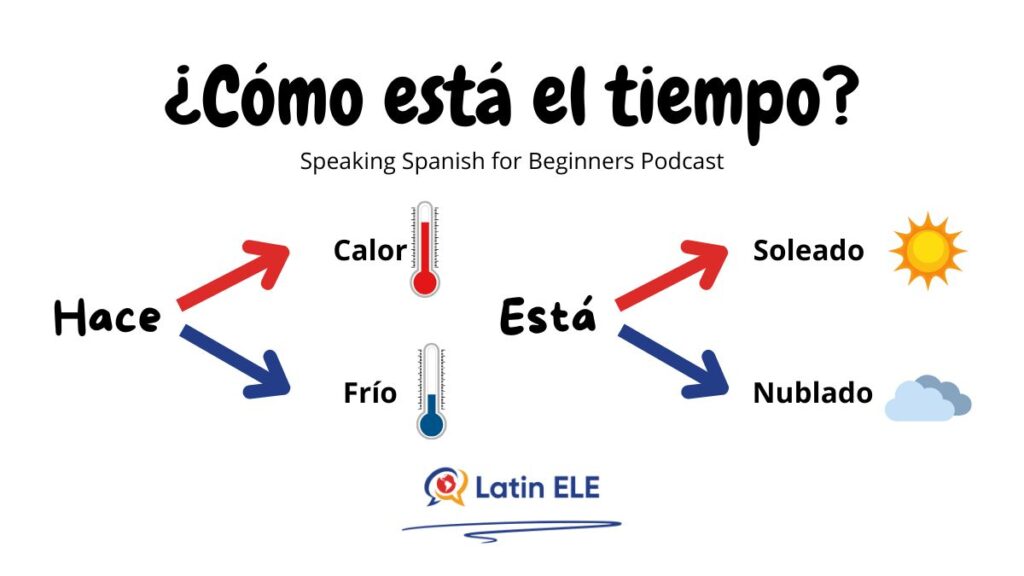
¿Cómo está el tiempo? = How’s the weather?
¿Qué tiempo hace? = What’s the weather like?
Some people also use el clima, though that’s more appropriate for long-term conditions. In other words, the equivalent of climate.
Verb Hacer
Hacer (to make/do) is used in the third person singular followed by a noun about atmospheric conditions.
In simple words, it’s always: hace + [weather condition].
Some examples:
Hace calor = It’s hot
Hace buen tiempo = The weather is nice
Hace sol = It’s sunny
Hace frío = It’s cold
Hace mal tiempo = The weather is bad
⚠️ Note: Don’t translate “hace” as “to make” into English. Learn the phrases about the weather with “hacer” as set expressions. No need to make things hard for yourself.
Verb Estar
The construction with estar (to be) feels more natural for English speakers.
We use estar + adjective to describe weather conditions:
Está soleado = It’s sunny
Está nublado = It’s cloudy
Está despejado = It’s clear
Está caluroso = It’s hot/warm
Additional Spanish Weather Words
Here are more useful words en español:
lluvia = rain
llover = to rain
nieve = snow
nevar = to snow
neblina = fog
viento = wind
Dialogue Transcript
Now that you’re familiar with these expressions, here’s a sample dialogue from the episode.
It will give you a clear idea of how to use these phrases in a real conversation.
| Spanish | English |
|---|---|
| Marco: Hola, Leticia, ¿qué tal? | Marco: Hi, Leticia, how are you? |
| Leticia: Hola, Marco. Bien, acá en Minnesota, visitando a unos amigos. | Leticia: Hi, Marco. Good, I’m here in Minnesota, visiting some friends. |
| Marco: ¿Minnesota? ¡Genial! Yo estoy en Costa Rica de vacaciones. Acá hace calor y está soleado. ¿Cómo está el tiempo en Minnesota? | Marco: Minnesota? Awesome! I’m in Costa Rica on vacation. Here it’s hot and sunny. How’s the weather in Minnesota? |
| Leticia: Acá hace frío y está nublado. Pero me gusta. | Leticia: Here it’s cold and cloudy. But I like it. |
Quiz Time!
It’s time to test your Spanish weather vocabulary! Try this quiz to practice the words you’ve just learned. ¡Mucha suerte! (Good luck!)
Now you know how to describe the weather in Spanish, you can use it as a conversation starter.
Talking about the weather is a great opener and it often leads to more interesting conversations.
Still not sure where to start your Spanish journey? Join our FREE course Spanish Kickstart: your first five lessons en español. (Unsubscribe anytime.)
¡Hasta pronto!

Marco Fierro — Spanish Beginners Cult Leader
¡Hola! I’m an enthusiastic Spanish teacher passionate about making my language accessible to YOU.
When I’m not teaching, I love traveling and rocking out on my electric guitar.
Book an online lesson with me and let’s get started. ¡Vamos!