

What are some things you like?
In this episode of Speaking Spanish for Beginners Podcast, you’ll learn how to talk about the things you enjoy (and don’t enjoy) en español.
To explore this topic, we’ll talk about TV series we like (and dislike) so you can better understand how to express your preferences in Spanish.
In this lesson, you’ll learn:
👍 How to use the verb gustar (to like)
🍿 Vocabulary about TV series
❌ How to talk about the things you don’t like
Ready? ¡Vamos!
Join our FREE 5-Day Spanish Course!

Ready to start learning Spanish but not sure where to begin?
Subscribe to Latin ELE’s newsletter and get access to Spanish Kickstart—a 5-day course with videos, study guides, and daily tips to help you start strong.
Unsubscribe anytime. No hard feelings
The Verb Gustar
A simple way to chat about your hobbies and favorite activities is by using the verb gustar.
This is the equivalent of “to like” in English, but it works differently.
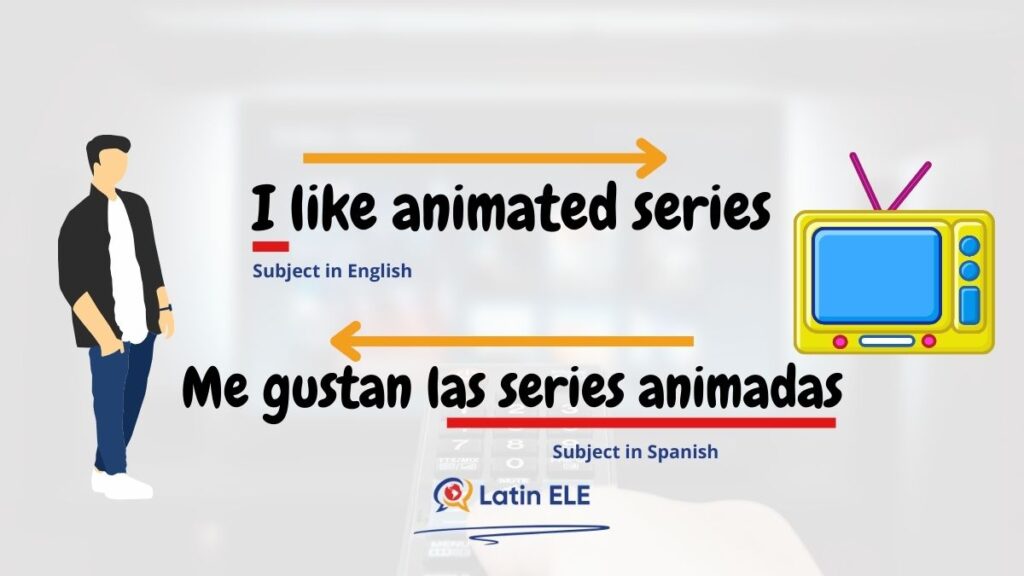
In English, you conjugate the verb to like with the personal pronouns (I, you, he etc.)
Example: I like animated series.
In Spanish, however, we conjugate gustar with the object that is liked, not the person who likes it.
So instead of saying “yo gusto las series” (❌), a Spanish speaker would say:
Las series me gustan (Animated series are pleasant to me.)
And even more naturally:
Me gustan las series.
To put it in a fun way: when using gustar, Spanish speakers sound like Yoda from Star Wars (to me pleasant are the series)
Forms of the Verb Gustar
Since the emphasis in Spanish is on the object (not the person who likes it), the verb gustar is used in the third person singular or plural.
If the thing you like is singular or an action (expressed with a verb), use gusta. Examples:
Me gusta el cine (I like cinema) / singular
Me gusta ver películas (I like watching movies) / action
If it’s plural, use gustan. Example:
Me gustan las películas de acción (I like action movies) / plural
Now let’s see when to use the indirect object pronouns (me, te, le, etc.) using the series South Park as an example:
| to me | (a mí) | me | gusta | la serie South Park |
| to you | (a ti) | te | ||
| to him / her | (a él/ella) | le | ||
| to us | (a nosotros/-as) | nos | ||
| to you / them | (a ustedes, ellos/-as) | les |
As you can see, the verb “gustar” remains “gusta” (third person singular).
That’s because it’s conjugated with “la serie South Park”, not with the person who likes the series.
Expressing Likes and Dislikes in Spanish
To talk about the things you like, you can use the form of “gustar” shown in the previous examples.
To say you don’t like something, simply add “no” before the construction with gustar.
Example:
✅ Me gusta Breaking Bad (affirmative)
❌ No me gusta Grey’s Anatomy (Negative)
Asking Questions about Things People Like
A common sentence structure you’ll use with your amigos is:
¿Te gusta/-n + object(s)? (Do you like + object?)
Examples:
¿Te gusta la nueva serie animada? (singular)
¿Te gustan las nuevas películas de Netflix? (plural)
Verbs Like Gustar
Other verbs follow the same structure as gustar:
- interesar = to be intereseted
- encantar = to love
Examples:
Me interesan las películas de terror (I’m interested in horror movies)
Me encantan las series de humor negro (I love dark humor series)
Note: Use encantar when you really love something. It expresses a stronger liking than gustar.
Compare:
Me gustan las películas románticas 👍
Me encantan las películas románticas 😍
“Gustar” Dialogue Transcript
In the episode, you’ll hear two friends talking about the series they like and don’t like.
Pay close attention to the structures they use and questions to express likes and dislikes.
| Spanish | English |
|---|---|
| Marco: ¿Te gusta alguna serie, Gaspar? | Marco: Do you like any TV series, Gaspar? |
| Gaspar: Sí, me gusta la serie Los Simpsons. Me gustan las series animadas de Estados Unidos. ¿Te gusta Los Simpsons? | Gaspar: Yes, I like the series The Simpsons. I like animated series from the United States. Do you like The Simpsons? |
| Marco: No mucho, pero me gustan otras series animadas. Me gusta South Park, y también me gusta Rick and Morty. Me gustan las series con humor negro. | Marco: Not much, but I like other animated series. I like South Park, and I also like Rick and Morty. I like shows with dark humor. |
| Gaspar: ¿Te gusta ver las series con tu esposa? | Gaspar: Do you like watching the shows with your wife? |
| Marco: No, a mi esposa no le gustan South Park ni Rick and Morty. Son muy extrañas y locas para ella. A ella le gustan las series románticas. | Marco: No, my wife doesn’t like South Park or Rick and Morty. They’re too strange and crazy for her. She likes romantic series. |
Vocabulary of TV Series
📺 A fun topic to express likes and dislikes is TV series. Here is some additional vocabulary to chat about your favorite shows:
series de acción: action series
series de terror: horror series
series de comedia: comedy series
series románticas: romantic series
series de ciencia ficción: sci-fi series
series de suspenso: thriller series
series de misterio: mystery series
series de crimen: crime series
Quiz Time: Gustar
Now that you know how to use gustar, it’s time to practice! Take the quiz and put your Spanish into action.
And now, it’s time to go out there an have fun conversations with Spanish native speakers.
With this, you can confidently talk about your hobbies, favorite movies, and everyday preferences en español.
And if you need extra resources to learn Spanish, our show Speaking Spanish for Beginners will help start Spanish on the right track.
¡Hasta pronto!

Marco Fierro — Your Latino Spanish Tutor
¡Hola! I’m an enthusiastic Spanish teacher passionate about making my language accessible to YOU.
When I’m not teaching, I love traveling and rocking out on my electric guitar.
Let’s have fun learning ESPAÑOL together. ¡Vamos!