
Your amigos latinos might ask you: “¿Cómo es tu ciudad?” (What’s your city like?). Would you know how to describe your hometown en español?
In this episode of Speaking Spanish for Beginners Podcast, you’ll learn the essential vocabulary and grammar to describe places in Spanish.
In this lesson you’ll discover:
🏬 Common adjectives to describe a place
📍 How to use the verbs ser, estar and haber
🏢 Useful vocabulary for places in a city
Ready? ¡Vamos!
Join our FREE 5-Day Spanish Course!
Ready to start learning Spanish but not sure where to begin?
Subscribe to Latin ELE’s newsletter and get access to Spanish Kickstart—a 5-day course with videos, study guides, and daily tips to help you start strong.
Unsubscribe anytime. No hard feelings
Vocabulary of Places in the City
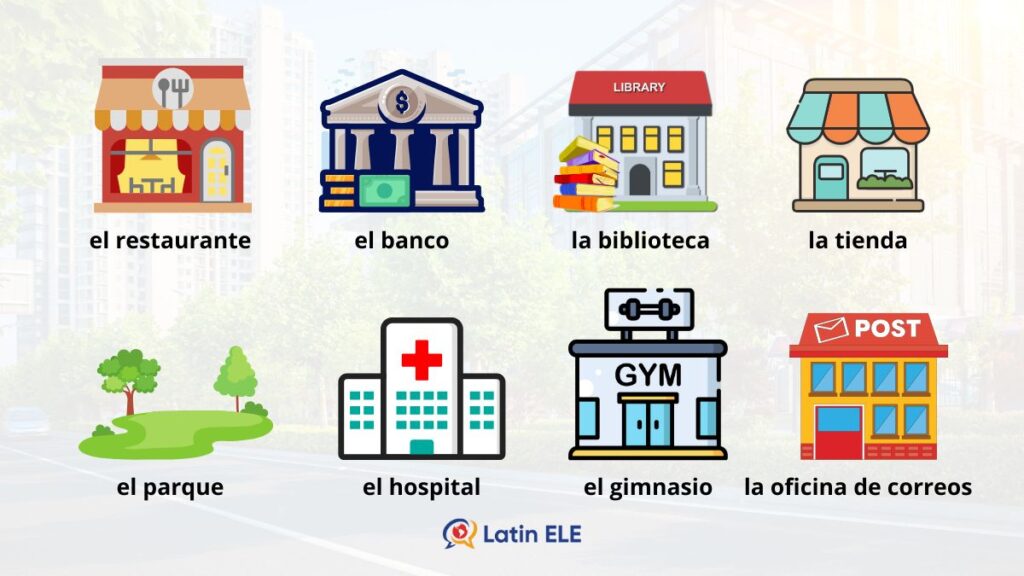
First, let’s get familiar with some common lugares (places) you’ll find in almost any city or town:
la tienda = store
la calle = street
la avenida = avenue
el parque = park
el hospital = hospital
la biblioteca = library
la librería = bookshop
la escuela = school
el banco = bank
el gimnasio = gym
el supermercado = supermarket
la oficina de correos = post office
Adjectives to Describe a Place
Here are some adjectives you can use when describing cities, towns, or neighborhoods:
grande = big
pequeño/-a = small
turístico/-a = touristy
industrial = industrial
moderno/-a = modern
antiguo/-a = old
animado/-a = lively
bonito/-a = beautiful
feo/-a = ugly
elegante = elegant
Using Ser, Estar and Haber
Once you have some vocabulary, it’s time to describe places with the right verbs:
Verb Ser
Use ser (to be) to describe the characteristics of a place. It’s usually followed by an adjective.
➡️ Example: La ciudad de Buenos Aires es grande y turística.
Verb Estar
Use estar (to be) to describe locations.
➡️ Example: La ciudad de Buenos Aires está en el centro del país.
Verb Haber
In Spanish, haber is used to talk about the existence of things. Its form hay means both “there is” and “there are.”
➡️ Example: Hay una biblioteca en mi ciudad. (singular)
➡️ Example: Hay muchos restaurantes. (plural)
💡 Notice that hay doesn’t change whether it’s singular or plural. Easy, right?
Spanish Dialogue: San Pedro de Atacama
In the podcast episode, Marco and a friend talk about San Pedro de Atacama, a city in northern Chile.
Marco describes the places and things you can find there.
Listen to the dialogue and see how many details you can catch en español.
| Spanish | English |
|---|---|
| Amiga: ¡Hola, Marco! El próximo mes viajo a San Pedro de Atacama. | Friend: Hi, Marco! Next month I’m traveling to San Pedro de Atacama. |
| Marco: ¿San Pedro de Atacama? ¡Qué bacán! Es un lugar muy bonito. Está en el norte de Chile, en el desierto de Atacama. | Marco: San Pedro de Atacama? How cool! It’s a very beautiful place. It’s in the north of Chile, in the Atacama Desert. |
| Amiga: Suena interesante. ¿Qué hay? | Friend: Sounds interesting. What’s there? |
| Marco: Hay tiendas de artesanía. Hay calles pequeñas. Hay restaurantes de comida local. Hay muchos lugares turísticos cerca del pueblo. | Marco: There are craft shops. There are small streets. There are local food restaurants. There are many tourist spots near the town. |
| Amiga: ¡Qué bien! | Friend: That’s great! |
| Marco: Sí, pero no hay playa. San Pedro de Atacama está en el desierto y por eso no hay mucha agua. | Marco: Yes, but there’s no beach. San Pedro de Atacama is in the desert and that’s why there isn’t much water. |
Test Your Spanish Vocabulary
Need some extra practice? Try this fun quiz to test what you’ve just learned.
Now you’re ready to describe your city, town, or neighborhood en español. It’s a great way to connect with your amigos latinos and make new friends!
And if you’d like more beginner-friendly lessons, check out the Speaking Spanish for Beginners Podcast—your go-to resource to start speaking confidently en español.
¡Hasta pronto!

Marco Fierro — Spanish Beginners Cult Leader
¡Hola! I’m an enthusiastic Spanish teacher passionate about making my language accessible to YOU.
When I’m not teaching, I love traveling and rocking out on my electric guitar.
Book an online lesson with me and let’s get started. ¡Vamos!